Thirty six questions. That is the whole paper. At a 68 percent pass mark the arithmetic is unforgiving: you need 25 right, which means 11 wrong answers end the attempt. Most Oracle application exams give you enough questions to absorb a weak area. This one does not.
That paper is 1Z0-1060-26, and the Oracle Accounting Hub Cloud certification behind it covers a product with a single job: turning transactions from systems Oracle did not build into journal entries in the Oracle general ledger. Ninety minutes, 245 USD, nine syllabus areas, and not one published weighting between them.
Table of Contents
- What does Oracle Accounting Hub Cloud actually do?
- What are the 1Z0-1060-26 exam facts?
- Why do 36 questions change how you prepare?
- How do you plan across nine unweighted areas?
- Registering the source systems
- What does the accounting rules engine ask you to build?
- What happens when a transaction fails to account?
- Reporting, automation and Redwood
- Who should take this exam?
- How should you prepare?
- Frequently Asked Questions
- Conclusion
What does Oracle Accounting Hub Cloud actually do?
It accounts for transactions that originate outside Oracle. A loan servicing platform, a policy administration system, a billing engine or a trading application produces business events; Accounting Hub registers that application as a source system, applies configurable rules to each event, and posts the resulting journal entries into the Oracle general ledger.
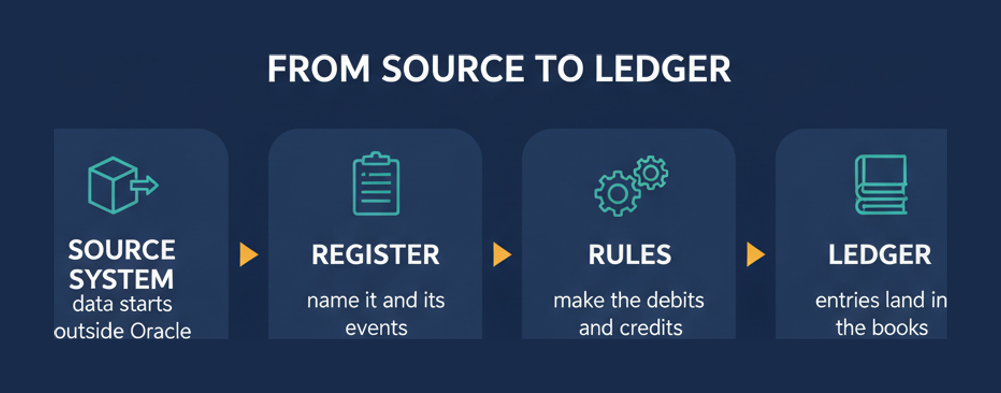
That is the difference between this credential and every other Oracle Financials paper. Payables, Receivables and the rest examine subledgers that generate their own transactions and come with their own accounting already built. Accounting Hub ships with no accounting at all. You build it, for data the product has never seen, which is why the blueprint spends so much of its attention on rules rather than on screens.
The practical value is that one transaction can produce several accounting representations at once. The same loan payment can be booked one way for statutory reporting and another for management reporting, from a single event, because the rules are defined per ledger. Organisations reporting under more than one framework need exactly that, and the IFRS accounting standards are a common reason a second representation exists in the first place.
One naming note that trips people up in search results and in job adverts. The product was Fusion Accounting Hub, and implementers still call it FAH. It is the same thing. Oracle’s current material sits under Oracle Cloud Financials, and the destination for everything the engine produces is the ordinary general ledger any accountant would recognise.
What are the 1Z0-1060-26 exam facts?
1Z0-1060-26 runs 90 minutes with 36 multiple choice questions at a 68 percent pass mark, which is 25 correct answers. It costs 245 USD, and passing grants the Oracle Accounting Hub Cloud 2026 Implementation Professional credential. Nine syllabus areas are published, with no weighting attached to any of them.
| Field | Value |
|---|---|
| Exam code | 1Z0-1060-26 |
| Exam name | Oracle Accounting Hub Cloud 2026 Implementation Professional |
| Questions | 36 |
| Duration | 90 minutes |
| Passing score | 68 percent, or 25 correct answers |
| Format | Multiple choice |
| Price | 245 USD, varies by country and local currency |
| Syllabus areas | 9, none weighted |
Two honest caveats about that table. The figures come from the exam catalogue rather than from a page Oracle publishes openly: Oracle’s own certification pages now resolve into an application shell that returns no readable specification, so nothing above could be confirmed a second time against the vendor. Confirm the price and the duration on the booking screen before you pay.
The second caveat concerns the code itself. The suffix rolls annually, so 1Z0-1060-24 and 1Z0-1060-25 were the same exam in earlier releases and still surface in search results. The current paper is the 26 release. If a study resource names an older suffix, most of its content will still apply, but the release-specific material at the end of the blueprint will not.
Nothing is published anywhere readable about a validity period, a retake window or a prerequisite, so this guide states none. That silence is itself worth knowing before you plan around an assumption.
Why do 36 questions change how you prepare?
Because the margin is thin and the coverage is wide. Nine areas across 36 questions averages four questions per area, and 68 percent leaves room for 11 wrong answers. Skip one area entirely and you have spent a third of your margin before you have misread a single question in the areas you did study.
Compare that with a 60 or 70 question paper at a similar pass mark, where a weak area can be carried by strength elsewhere. Here the arithmetic works the other way. Two shaky areas is a fail even if everything else is solid, which makes breadth the priority and depth the luxury.
It also changes what practice is for. With four questions per area, a practice set is not primarily a score check; it is a coverage check. The useful output is the list of areas the questions touched that you could not answer at all, and the fastest way to produce that list is to work through a set of 1Z0-1060-26 sample questions early rather than as a final rehearsal.
Ninety minutes for 36 questions is 150 seconds each, which is generous by Oracle standards and reflects the kind of question a configuration exam asks. Expect scenarios that describe a requirement and ask which component delivers it, rather than recall of a menu path.
How do you plan across nine unweighted areas?
You plan by structure, not by percentage, because Oracle publishes no weightings for this exam and the catalogue does not invent any. What the blueprint does reveal is its own shape: some areas list a single objective, while one lists nine separate component types. That imbalance is the closest thing to a weighting signal available.
| Syllabus area | What it covers |
|---|---|
| Common application and Accounting Hub capabilities | Functional Setup Manager, role-based access control, the Security console, core Accounting Hub activities |
| Enterprise structure, reporting structures and ledgers | Legal entities, financial reporting structures, the role of ledgers |
| Analyzing accounting transformation requirements | Source transaction lifecycle, registration requirements, accounting event model, accounting attributes |
| Registering source systems | Registering and updating source systems |
| Configuring accounting rules | Formulas, supporting references, description rules, mapping sets, account rules, journal line rules, journal entry rule sets, accounting methods |
| Uploading transaction data | Spreadsheet and automated upload, error correction, exceptions, adjustments |
| Leveraging reporting tools | OTBI, Financial Reporting Web Studio, BI Publisher, Smart View, account groups |
| AI, machine learning, mobile and automation | Automation features that streamline processing |
| Enabling Redwood capabilities | Enabling Redwood and its effect on existing configuration |
Read that table as a sequence rather than a list. Areas three, four, five and six describe one continuous journey: understand what the source system produces, register it, define how its events become journal entries, then move the data and deal with what breaks. Studying them in that order costs nothing extra and makes each one explain the next.
Areas one, two, seven, eight and nine are context around that spine. They are not filler, and with four questions per area on average they carry the same nominal weight as the rest, but they are the parts an experienced Fusion implementer is most likely to already know.
Registering the source systems
Source system registration is the step that has no equivalent on any other Oracle Financials exam, and it gets an area of its own. Registering a source system tells Accounting Hub what kind of application is sending data, what transaction types it produces, and what attributes travel with each event so the rules have something to work with.
The examinable content splits cleanly. Analysis comes first: identifying the transaction lifecycle inside the source application, establishing what registration will require, and designing an accounting event model that names the events worth accounting for. Registration itself, and updating a registration when the source application changes, follows from that analysis.
The design decision worth understanding properly is the accounting event model. Get it wrong and every rule built on top of it is aimed at the wrong thing. A question that describes a business process and asks which events should be registered is testing this, and no amount of fluency with the rules screens will rescue an answer.
Accounting attribute assignment belongs to the same analysis. Attributes are the fields the rules can reference later, so deciding what the source system must send is an early and largely irreversible decision. Oracle’s Accounting Hub implementation guide is the reference for the mechanics if you have no environment to explore.
What does the accounting rules engine ask you to build?
Eight named component types, which makes this the largest single block on the blueprint. User-defined formulas, supporting references, description rules, mapping sets, account rules, journal line rules, journal entry rule sets and accounting methods each do a distinct job, and the exam expects you to know which one solves a described requirement.
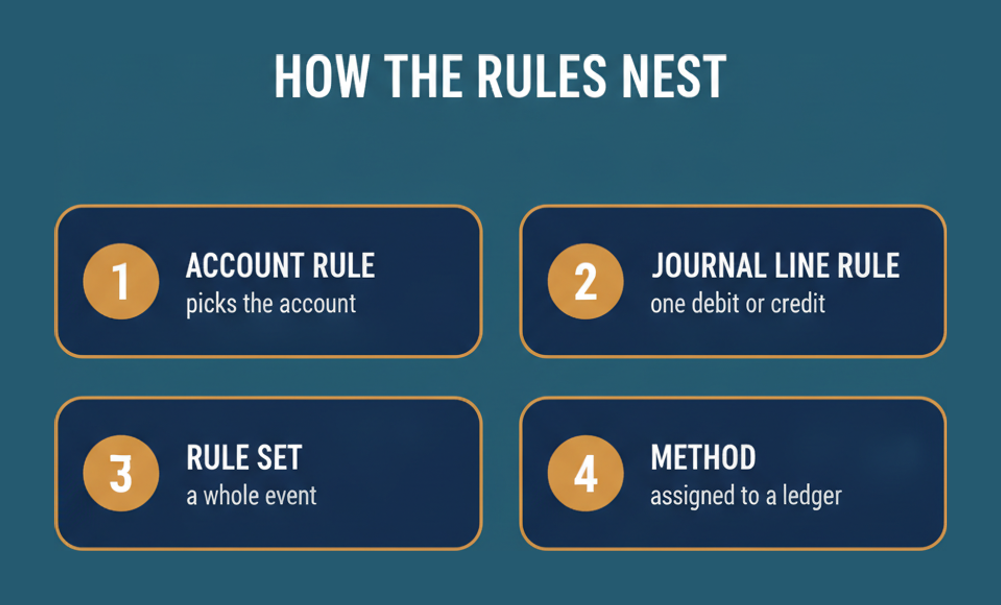
They nest, and the nesting is the thing to learn. Account rules and description rules are assembled into journal line rules, which determine the individual debit and credit lines. Journal line rules are collected into journal entry rule sets, which handle a complete event. Rule sets are gathered into an accounting method, which is what a ledger is actually assigned.
- Mapping sets translate a source value into an accounting value, such as a product code into a natural account
- User-defined formulas calculate amounts the source system did not supply
- Supporting references carry source detail into the ledger so balances can be analysed by it later
- Description rules build the text that appears on the journal line
- Account rules determine which account a line posts to, conditionally
Supporting references deserve separate attention because they are the component most often underused in practice and most often misunderstood in questions. They are how you retain the source system’s own dimensions after the transaction has become a general ledger balance, and choosing them late is expensive.
The reason the hierarchy matters for the exam is that a scenario can be solved at more than one level, and only one answer is the right one. A requirement to vary an account by transaction type is an account rule question. A requirement to produce a different set of lines entirely is a rule set question. Recognising which layer is in play is most of the skill.
What happens when a transaction fails to account?
It becomes an exception, and handling exceptions is examinable in its own area alongside loading the data. Transactions arrive by spreadsheet or by automated upload, the accounting rules run against them, and anything the rules cannot resolve stops rather than posting something wrong into the ledger.
The blueprint names three related tasks: uploading transaction data, correcting errors and managing exceptions, and creating adjustments. They are not the same activity. An error is data that failed validation on the way in. An exception is data that arrived cleanly but could not be accounted, usually because a rule has no answer for the values it received. An adjustment is a deliberate correction to accounting that already happened.
Most exception questions resolve to a diagnostic instinct: when a transaction will not account, the fault is nearly always a rule that does not cover the case, not a defect in the upload. Practising that reasoning on a described scenario is more useful than memorising the screens, and anyone who prepared for an earlier release of this exam will find the earlier 1Z0-1060 material still largely applicable here.
Reporting, automation and Redwood
Three areas sit after the accounting engine, and together they account for roughly a third of the blueprint’s areas even though they are the parts implementers tend to prepare least. Reporting is the largest of the three, naming five distinct tools, while automation and Redwood carry one objective each.
The reporting tools divide by purpose rather than by preference. OTBI answers analytical questions interactively. Financial Reporting Web Studio builds statutory-style financial reports. BI Publisher produces schedulable, formatted output. Smart View brings ledger data into a spreadsheet. Account groups organise what the reports address. A question naming a reporting requirement is usually testing which of those five is the correct instrument.
Redwood is the current Oracle interface generation, and the objective is specific: enabling Redwood capabilities and understanding their implications for existing configuration. The second half is the examinable half. Turning it on is straightforward; knowing what it changes for configuration that already exists is the point, and it is also the area most likely to differ from whatever release you last worked on.
The AI, machine learning, mobile and automation area is the vaguest objective on the blueprint, phrased as using those features to streamline processing and improve operational efficiency. Treat it as awareness-level: know which automation capabilities exist in the current release and what they remove manual effort from.
Who should take this exam?
People who implement Accounting Hub, and a narrower group than the exam name suggests. It suits functional consultants integrating a non-Oracle application into Oracle Financials, finance systems analysts responsible for subledger accounting, and Fusion implementers who have been handed a source system and asked to make it produce journal entries.
It suits fewer people than the broader Financials credentials do, which is the honest position. If your work is Payables, Receivables or General Ledger configuration and no external system feeds your accounting, this paper examines a product you will not touch. The adjacent papers serve you better, and the same reasoning applies in reverse to a credential such as the EPM data integration certification, which addresses a different flow of financial data entirely.
Where it earns its place is on integration-heavy engagements, and in industries where the systems of record are specialised: banking, insurance, utilities, telecommunications, anywhere the transaction volume lives in an application built for that industry rather than in an ERP subledger. Accounting Hub is often the only viable route to a supportable ledger in those estates.
Experience assumptions are not published, but the blueprint makes them plain enough. Areas one and two expect existing familiarity with Functional Setup Manager, security configuration and ledger structures, so this is not a reasonable first Oracle Cloud exam.
How should you prepare?
Build the rules yourself, in that order, and use practice to find the areas you have not covered rather than to confirm the ones you enjoy. With four questions per area and room for only 11 wrong answers, coverage beats depth, and the blueprint’s own sequence is a better study plan than any reordering of it.
- Read the nine areas and mark the ones you have never configured, because those are the ones that will cost you the margin.
- Work the transformation spine in order: source analysis, registration, accounting rules, then upload and exceptions.
- Build one complete accounting method from the bottom up, starting with an account rule and finishing with the method assigned to a ledger, so the hierarchy is something you have assembled rather than read.
- Take one realistic requirement and design the accounting event model for it before touching any configuration screen.
- Learn the five reporting tools by what each one is for, since that is how the questions frame them.
- Read the current release notes for Redwood and note what it changes for existing configuration.
- Sit a full timed set of 36 and use the result as a coverage audit, then study the gaps it exposes.
If you have no access to an environment, the implementation documentation carries the component definitions and the order in which they combine, which is enough to learn the hierarchy even without a screen to click. What it cannot give you is the judgement about which layer solves a requirement, and that is worth borrowing an environment for.
Frequently Asked Questions
How many questions are on the 1Z0-1060-26 exam?
Thirty six multiple choice questions in 90 minutes, which is about 150 seconds each.
What is the passing score for 1Z0-1060-26?
Sixty eight percent, which is 25 correct answers out of 36. That leaves room for 11 wrong ones.
How much does the exam cost?
Two hundred and forty five US dollars, though Oracle varies pricing by country and local currency, so confirm the figure when you book.
What credential does passing it earn?
Oracle Accounting Hub Cloud 2026 Implementation Professional.
Are the nine syllabus areas weighted?
No. Oracle publishes no weightings for this exam, so plan by area rather than by percentage. Nine areas across 36 questions averages four questions each.
Is Accounting Hub the same thing as Fusion Accounting Hub?
Yes. FAH is the older name and implementers still use it, which is why it appears in search results and job adverts alongside the current one.
What is the difference between this and the other Oracle Financials exams?
The other papers examine subledgers that produce their own transactions with accounting already built. Accounting Hub accounts for transactions from applications Oracle did not build, so you configure the accounting yourself.
What do 1Z0-1060-24 and 1Z0-1060-25 refer to?
Earlier annual releases of the same exam. The suffix rolls each year and the current paper is the 26 release, so older codes still appear in search results but are superseded.
Are there prerequisites?
None are published. The blueprint assumes working familiarity with Functional Setup Manager, security configuration and ledger structures, so it is not a sensible first Oracle Cloud exam.
How long is the certification valid?
No validity period is published anywhere that can be read, so this guide does not state one. Check your certification record after you pass.
Conclusion
1Z0-1060-26 is a configuration exam for a product with an unusual job: accounting for transactions that originate outside Oracle. Thirty six questions, 90 minutes, 68 percent to pass, 245 USD, and nine areas that Oracle declines to weight.
The short paper is the planning constraint. Twenty five correct answers is the bar and 11 wrong ones is the whole allowance, so cover every area before deepening any of them. Learn the accounting rules hierarchy by building one, because it is the largest block on the blueprint and the one that rewards assembly over reading.
Treat the published figures as the catalogue’s rather than the vendor’s, since no readable Oracle page confirms them, and check the current release notes for what Redwood changes. Then work the transformation spine in the order the blueprint gives it, which is the only prioritisation this syllabus offers.


