The workshop has been running for two hours. One wall is a claims process in sticky notes, the analyst at the whiteboard is redrawing it as BPMN, and the room has just spent twenty minutes arguing whether a gateway should be exclusive or parallel. Then the operations director asks a different question: which of this year’s objectives does the new process actually serve, and how will anyone know it is working?
That second question is the one the OCEB 2 certification cares about most. OMG’s Fundamental exam, OMG-OCEB2-FUND100, is the entry point to the whole OCEB 2 track, and only 40 percent of its marks come from BPMN. The other 60 percent test business motivation, process governance frameworks and the basics of how a business runs, which is exactly what that director was asking about.
Table of Contents
- What is the OCEB 2 certification, and where does Fundamental fit?
- What are the OCEB 2 Fundamental exam facts?
- How are the marks split between BPMN and everything else?
- What do the two BPMN topics actually test?
- Why is the Business Motivation Model worth 16 percent?
- Nine frameworks in 15 percent: how deep do you go?
- The business half: processes, BPM and goals
- Who should start with OCEB 2 Fundamental?
- How do booking, languages, retakes and validity work?
- How should you prepare for OMG-OCEB2-FUND100?
- Frequently Asked Questions
- Conclusion
What is the OCEB 2 certification, and where does Fundamental fit?
OCEB 2, the OMG Certified Expert in BPM 2, is the Object Management Group’s business process management certification track. It has three exams: Fundamental, Intermediate and Advanced. Fundamental has no prerequisite of its own, and it is the required first step before either higher level can be taken.
The three levels describe three different jobs. OMG positions a Fundamental holder as someone who can work productively on a BPMN project team. Intermediate moves to designing and running a BPM project of moderate scope, and Advanced is aimed at people who lead large, enterprise-wide BPM programmes and advise senior management.
| Level | What OMG says it tests | Who it is for |
|---|---|---|
| Fundamental | Business concepts, business motivation and planning, processes and process management, BPMN elements in the descriptive and analytic conformance classes, quality, governance and metrics frameworks | A productive member of a BPMN project team |
| Intermediate | BMM influencers and assessments, shared business vocabulary, KPIs, business activity monitoring, simulation, ROI modeling, compliance frameworks | A team member or lead on a BPM project of moderate scope |
| Advanced | Aligning BPM with enterprise goals, advanced modeling, running BPM programmes, change management, compliance and assurance | A leader of major BPM implementations or a BPM Center of Excellence |
Because Fundamental gates the other two, every OCEB 2 holder has passed it. OMG’s BPM certification page carries the exam information sheet for each level, and it is worth reading the Fundamental one before anything else.
What are the OCEB 2 Fundamental exam facts?
OMG-OCEB2-FUND100 is a 90 question multiple choice exam. Candidates in native English-speaking countries get 90 minutes and everyone else gets 120. You need 62 correct answers to pass, which OMG also expresses as 69 percent. The fee is 350 US dollars plus local taxes, and the exam is booked through Pearson VUE.
| Field | Value |
|---|---|
| Exam name | OMG Certified Expert in BPM 2 – Fundamental |
| Exam code | OMG-OCEB2-FUND100 |
| Questions | 90, multiple choice, using both text and images |
| Duration | 90 minutes in native English-speaking countries, 120 minutes elsewhere |
| Passing score | 62 of 90 correct |
| Fee | 350 US dollars plus taxes |
| Prerequisites | None |
| Languages | English and Japanese |
| Delivery | Pearson VUE test centre or online |
| Validity | 3 years from the exam date |
Two numbers in that table shape everything else. First, 62 of 90 means you can afford 28 wrong answers, a reasonable margin until you notice how the marks are spread. Second, the image questions are real: some items show you a diagram rather than describe one, so recognising BPMN symbols instantly matters as much as knowing their definitions.
The extra 30 minutes outside native English-speaking countries is applied after you order the exam. OMG confirms it by email, so check that message rather than assuming the longer time is on your booking.
How are the marks split between BPMN and everything else?
BPMN carries 40 percent of OCEB 2 Fundamental across two topics, concepts at 24 percent and modeling skills at 16. The remaining 60 percent spreads over five topics: business motivation at 16, governance and metrics frameworks at 15, process fundamentals at 11, BPM fundamentals at 10 and business goals at 8.
| Topic | Weight | Roughly how many of 90 |
|---|---|---|
| Business Process Modeling Concepts | 24% | 22 |
| Business Motivation Modeling | 16% | 14 |
| Business Process Modeling Skills | 16% | 14 |
| Process Quality, Governance and Metrics Frameworks | 15% | 13 to 14 |
| Business Process Concepts and Fundamentals | 11% | 10 |
| Business Process Management Concepts and Fundamentals | 10% | 9 |
| Business Goals, Objectives | 8% | 7 |
The question counts are approximations from the weightings, not published figures, but they make the risk visible. A candidate who models BPMN every day and ignores everything else can bank perhaps 36 questions at best, which is well short of 62. The pass mark needs about 26 more, and they can only come from the business side.
The weightings and topic scopes are identical on OMG’s own information sheet and on the OCEB 2 Fundamental syllabus, so you can plan against them with confidence. Treat the list above as your study budget, not just a description of the paper.
What do the two BPMN topics actually test?
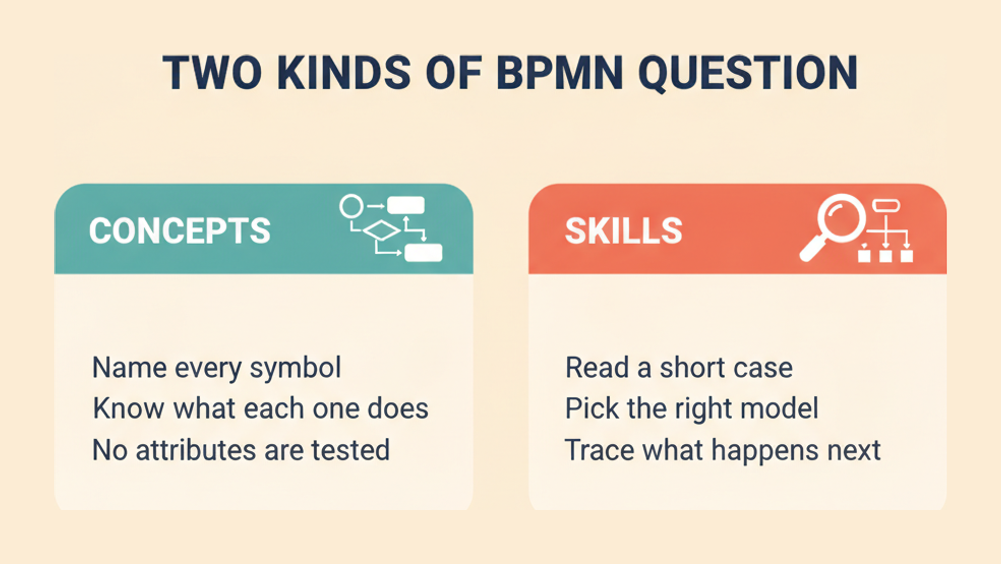
The two BPMN topics split knowing the notation from using it. Business Process Modeling Concepts, at 24 percent, tests the definition and use of every element in BPMN 2.0.2’s descriptive and analytic conformance subclasses. Business Process Modeling Skills, at 16 percent, gives you short scenarios as a diagram or a few sentences and asks you to reason about them.
Concepts: the element vocabulary
The concepts topic is the notation itself: events, activities, gateways, sequence and message flows, pools, lanes and the grouping elements that organise a model. OMG’s information sheet points to specific parts of the specification, including the conformance tables in chapter 2 and the basic and extended modeling element tables in chapter 7, with the focus on Process and Collaboration diagrams.
One boundary saves real time. Element attributes are explicitly not examined, so you need to know what an element is for and how it behaves, not every property it can carry. The analytic subclass is still larger than what most teams use day to day, so expect questions on elements you rarely draw.
Skills: reading a situation
The skills topic is closer to real work. A question might describe a hand-off between two departments and ask which construct models it correctly, or show a diagram and ask what happens when a particular event fires. This is where the image-based questions concentrate.
“It is intended to be used directly by the stakeholders who design, manage and realize business processes, but at the same time be precise enough to allow BPMN diagrams to be translated into software process components.”
That dual purpose explains the question style. The exam expects diagrams a business reader can follow and that are still precise, and the BPMN 2.0.2 specification is the reference that settles any argument about what a symbol means.
Why is the Business Motivation Model worth 16 percent?
The Business Motivation Model, BMM 1.3, is worth 16 percent because it is how OMG expects a process professional to connect work to intent. The topic covers vision, goals, objectives, mission, strategies, tactics, and the difference between ends and means. It carries exactly as much weight as the BPMN skills topic.
BMM is the part of the paper that answers the operations director from the workshop. It gives a precise vocabulary for why a process exists, and the exam uses that precision. Most questions turn on distinctions that everyday business language blurs.
- A vision is an overall image of what the organisation wants to be or become, while a mission describes its ongoing operational activity.
- A goal tends to be longer term and defined qualitatively, while an objective is a time-targeted, measurable step toward a goal.
- Ends are the vision and the desired results, meaning goals and objectives; means include the mission and the courses of action.
- Strategies generally support goals, while tactics implement strategies and generally support objectives.
Candidates who come from project work often treat goal and objective as synonyms, and that habit costs marks here. OMG’s information sheet points to chapters 1, 7 and 8 of the BMM specification, which define the core elements, so read those rather than a summary.
Nine frameworks in 15 percent: how deep do you go?
The Process Quality, Governance and Metrics Frameworks topic names nine frameworks and gives them 15 percent together, roughly 13 or 14 questions. That is about one or two questions per framework, so the exam tests recognition and purpose: what each framework is for and when an organisation would use it, not detailed application.
| Framework | What to know it for |
|---|---|
| APQC Process Classification Framework | A standard taxonomy of business processes used for comparison and benchmarking |
| SCOR | A reference model for supply chain processes and their performance measures |
| Value Chain Reference Model | A reference model for describing an organisation’s value chain |
| Business Process Maturity Model | OMG’s own staged model for how mature an organisation’s processes are |
| Six Sigma | Data-driven improvement, including the DMAIC cycle and control charts |
| Balanced Scorecard | Translating strategy into measures across several perspectives |
| COBIT | Governance and control of enterprise IT |
| Basel II | Capital and risk rules for international banking |
| Sarbanes-Oxley | US legislation on financial reporting and internal controls |
BPMM deserves slightly more attention than the rest, because it is OMG’s own standard and the information sheet points to specific chapters of it. For the two regulatory entries, knowing the purpose is enough. The Basel Committee’s Basel II framework is long, and the exam asks why such rules shape process design, not what the capital ratios are.
The business half: processes, BPM and goals
Three topics worth 29 percent together cover how a business and its processes work. Business process fundamentals takes 11 percent, BPM fundamentals takes 10, and business goals and objectives takes 8. They are the easiest marks to underrate, because the material looks like common sense until the questions ask for precise distinctions.
Process and BPM fundamentals
The process topic covers discovering processes, their characteristics, the difference between an As-Is and a To-Be model, levels of process modeling, and tying processes to goals. The BPM topic contrasts a functional organisation with a process-centric one, and covers styles of process management, stakeholder roles and responsibilities, and the tools that support BPM.
Business goals and objectives
The 8 percent business topic is the one that surprises technical candidates. It covers strategy, planning and goal-setting, plus project management, marketing, staffing and finance at an introductory level. OMG’s recommended reading for it includes two general MBA primers, which shows the intended depth: broad literacy, not specialist knowledge.
This business literacy is also where most candidates arrive underprepared. The site’s OCEB2 FUND100 resource page collects the Fundamental exam material in one place, and it is worth reading against the business half of the syllabus before you book.
Who should start with OCEB 2 Fundamental?
OCEB 2 Fundamental suits business analysts, process analysts, BPM team members and anyone who models or improves processes and wants a vendor-neutral credential. It has no prerequisites. It suits people whose work spans both the diagram and the business case, because that is how the exam is weighted.
Three profiles tend to find it a good fit:
- Business analysts who already draw process maps and want a standard notation and a recognised credential behind them.
- Process improvement practitioners from a Six Sigma or quality background, who will find the frameworks topic familiar and need to build up the BPMN side.
- Technical staff who implement workflows in a BPM or automation tool and need to understand the business models those workflows serve.
“The BPM certifications helped me gain a greater knowledge of business process notation, how to accurately model processes and how to deal with various scenarios while modeling”
If your work is purely technical and never touches goals, stakeholders or governance, expect the business topics to take longer than the BPMN ones. That is not a reason to skip the exam, but it should change how you plan your time.
How do booking, languages, retakes and validity work?
You book OMG-OCEB2-FUND100 through a Pearson VUE account, at a test centre or online. The exam is available in English and Japanese. Cancelling more than 24 hours before the appointment brings a full refund. A failed attempt’s score report includes a 20 percent discount code for a retake, and the certification lasts three years.
Pearson VUE’s OMG exam booking page now lists the credential as the EDMA-Certified Expert in Business Process Management 2, under the EDM Association, the wider body that OMG belongs to. OMG’s own certification page and information sheet still use the OMG name and publish the syllabus described here, so study from those. If you choose online delivery, run Pearson VUE’s system test on the computer you will use before you book.
Validity matters more than most candidates expect. OMG states that certifications expire three years after the exam date, and that passing the same or a higher level exam extends them. In practice, that means moving on to Intermediate within three years also keeps the credential current. Passing candidates receive a Credly digital credential, usually within hours.
How should you prepare for OMG-OCEB2-FUND100?
Prepare in proportion to the weightings: roughly two fifths of your time on BPMN and three fifths on business motivation, frameworks and business fundamentals. Work from the primary specifications OMG names, practise reading diagrams quickly, and test yourself on scenario questions before booking.
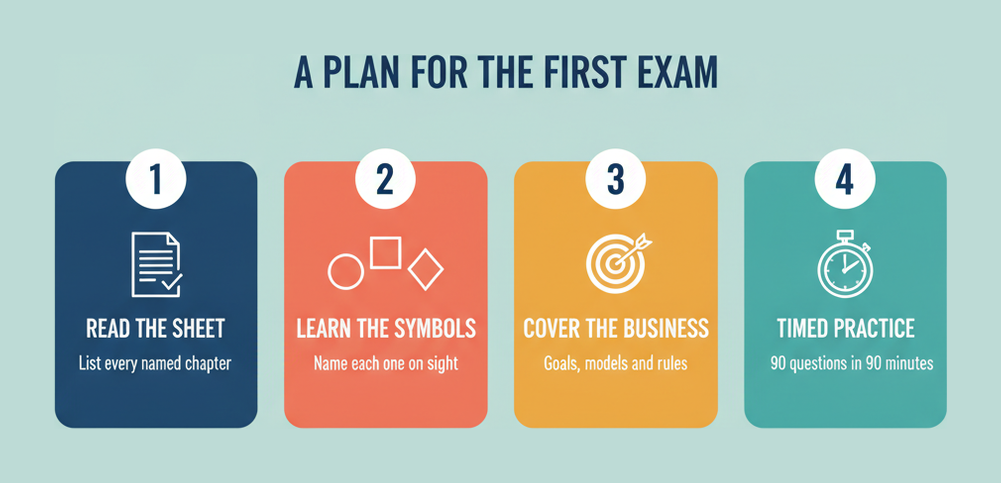
- Read the Fundamental information sheet and list every specification chapter and book it names, so your reading follows the exam rather than a general BPM course.
- Learn the BPMN elements in the descriptive and analytic conformance subclasses until you can name any symbol on sight.
- Model three or four real processes you know in BPMN, including at least one collaboration with two pools.
- Study BMM chapters 1, 7 and 8 and practise sorting statements into ends and means.
- Build a one-line summary of each of the nine frameworks and what it is used for.
- Cover the business fundamentals with an introductory business text, as OMG’s own reading list suggests.
- Work timed scenario questions to check your pace against 90 questions in 90 minutes.
For the process side, the textbook Fundamentals of Business Process Management is useful. Its authors are Dumas, La Rosa, Mendling and Reijers, and OMG’s information sheet lists the book’s early chapters on process identification and modeling.
Once Fundamental is done, the next step on the same track is covered in the site’s OCEB 2 Intermediate overview, which shows how BMM and governance deepen at the second level.
Frequently Asked Questions
What is the OCEB 2 certification?
OCEB 2, the OMG Certified Expert in BPM 2, is the Object Management Group’s business process management certification. It has three levels, Fundamental, Intermediate and Advanced, and every candidate starts with Fundamental.
How many questions are on the OCEB 2 Fundamental exam?
Ninety multiple choice questions, some presented as text and some as images such as BPMN diagrams.
What is the passing score for OMG-OCEB2-FUND100?
You need 62 correct answers out of 90. OMG also expresses this as 69 percent.
How long is the exam?
Ninety minutes in native English-speaking countries and 120 minutes everywhere else. OMG confirms the extra time by email after you order the exam.
Are there prerequisites for OCEB 2 Fundamental?
No. Fundamental has no prerequisites, but it is itself the prerequisite for the Intermediate and Advanced exams.
How much of the exam is BPMN?
Forty percent. Business Process Modeling Concepts is 24 percent and Business Process Modeling Skills is 16 percent. The other 60 percent covers business motivation, frameworks and business fundamentals.
How much does the exam cost?
The fee is 350 US dollars plus taxes, or the regional currency equivalent, paid when you book through Pearson VUE.
How long does the certification last?
Three years from the exam date. Passing the same or a higher level exam extends it.
Which languages is the exam offered in?
English and Japanese. Translation apps are not allowed during the exam.
Conclusion
The OCEB 2 certification starts with one exam for everyone: OMG-OCEB2-FUND100, with 90 questions, 62 correct needed to pass, 350 US dollars, and 90 or 120 minutes depending on where you sit it. It has no prerequisites, and it is the gate to both higher levels.
The most useful thing to know before you start is the split. BPMN is 40 percent of the marks, and even a flawless modeler cannot pass on BPMN alone. Business motivation, the nine frameworks and the business fundamentals decide the result, so plan your preparation around them as much as around the notation.
Start with the official weightings and the specification chapters OMG names, then practise on scenarios until reading a diagram feels as natural as drawing one.


