Almost half of the Adobe Journey Optimizer certification exam is about one thing. Campaign and Journey Optimization carries 48 percent of AD0-E607, the Adobe Journey Optimizer Business Practitioner Professional exam, and the other three domains share what is left. That weighting tells you who Adobe wrote the exam for: the person who builds a journey, checks it before it goes live, and reads the results afterwards, not the person who wires up the data behind it.
AD0-E607 is a 50-question, 100-minute test with a passing score of 31 out of 50 and a fee of $125. It sits at Adobe’s Professional level, which Adobe pitches at people with up to a year on the product. A second Journey Optimizer credential, AD0-E606 Developer Expert, exists for the technical side, and the two are easy to confuse. This article sets out both, walks through the four AD0-E607 domains with the published objectives, explains the two-year renewal, and ends with a preparation order that follows the weightings.
Table of Contents
- Is There an Adobe Journey Optimizer Certification?
- What Does the AD0-E607 Exam Test Across Its Four Domains?
- Why Do Journeys Carry 48 Percent of the Marks?
- How Do Offer Decisioning and Content Authoring Fit Together?
- What Does Foundations of AEP Mean for a Marketer?
- Business Practitioner Professional or Developer Expert: Which One?
- Who Should Take AD0-E607?
- How Much Does It Cost and How Does Renewal Work?
- How Should You Prepare for AD0-E607?
- Frequently Asked Questions
- Conclusion
Is There an Adobe Journey Optimizer Certification?
Yes. Adobe offers the Adobe Journey Optimizer Business Practitioner Professional certification, exam code AD0-E607: 50 questions, 100 minutes, 31 correct answers to pass, and a $125 fee. It is one of two Journey Optimizer credentials; the other, AD0-E606 Developer Expert, covers administration, APIs and data modelling for technical roles rather than campaign and journey work.
Journey Optimizer is Adobe’s application for designing and delivering personalised customer journeys across email, SMS, push and other channels, built on Adobe Experience Platform. Adobe sometimes shortens it to AJO. The Business Practitioner exam checks that you can use the product as a marketer or campaign owner: build journeys, decide on offers, author content and understand the platform data underneath.
| AD0-E607 exam fact | Value |
|---|---|
| Certification name | Adobe Journey Optimizer Business Practitioner Professional |
| Number of questions | 50 |
| Duration | 100 minutes |
| Passing score | 31 out of 50 |
| Exam fee | $125 USD ($95 in India) |
| Level | Professional, 0 to 12 months of experience |
| Language and delivery | English, online proctored with camera access |
| Recommended training | AJO-BP200, about six hours |
Adobe publishes the full record for this exam on its Journey Optimizer certification page, and every figure above matches what the EduSum syllabus page lists. There is no version number attached to the exam and no retirement date has been announced.
What Does the AD0-E607 Exam Test Across Its Four Domains?
AD0-E607 is split into four weighted sections: Campaign and Journey Optimization at 48 percent, Content Authoring at 20 percent, Foundations of AEP at 20 percent and Offer Decisioning at 12 percent. Across the four there are 25 published objectives, almost all of them phrased as scenarios, so the exam asks what you would do rather than what a feature is called.
The objectives below are reproduced as the syllabus states them. Each row is a fair guide to the question type: “Given a scenario” means a short situation followed by a choice of actions, while “Identify” items are closer to recall.
| Domain | Weight | Objectives |
|---|---|---|
| Campaign and Journey Optimization | 48% | Given a scenario, identify how to build a Customer Journey; Given a scenario, determine how to validate a Customer Journey; Given a scenario about after a Journey is run, identify how to evaluate the Customer Journey; Given a scenario, identify when to use unitary event or business event |
| Offer Decisioning | 12% | Identify how to create a collection of offer; Identify the stages of offer decisioning; Identify how to configure an offer; Given a scenario, identify how to use offer decision activities in content being authored; Given a scenario, identify when to use offer decisioning or personalization at scale; Given a scenario, differentiate between static and dynamic offers |
| Content Authoring | 20% | Identify how to use asset essentials; Given a scenario, identify how to add personalized fields into emails; Given a scenario, identify the appropriate configuration for the content experiment; Given a scenario, identify how to interpret content experiment; Identify the benefits of using fragments; Identify the types of fragments; Identify how to create an email template |
| Foundations of AEP | 20% | Given a scenario, determine when to use different types of data; Identify where to review profiles attributes and audience membership; Differentiate between datasets enabled for profile and datasets not enabled for profile; Identify different types of identities supported in Journey; Given a scenario, identify when to use a particular audience type; Given a scenario, identify the right logic to use for sequential audience; Given a scenario, identify how to troubleshoot a data loading issue; Given a scenario, identify which data label is appropriate |
On a 50-question paper the weights translate to roughly 24 questions on journeys, 10 each on content and platform foundations, and 6 on offers. The passing score of 31 means you can miss 19 questions in total, so a weak offer section is survivable; a weak journey section is not.
Why Do Journeys Carry 48 Percent of the Marks?
Campaign and Journey Optimization is 48 percent of AD0-E607 because building, validating and evaluating journeys is the daily work of a Journey Optimizer business practitioner. The domain has only four objectives, which means each one is tested from several angles: how to build a customer journey, how to validate it, how to evaluate it after it runs, and when a unitary event or a business event is the right trigger.
Build, validate, run, evaluate
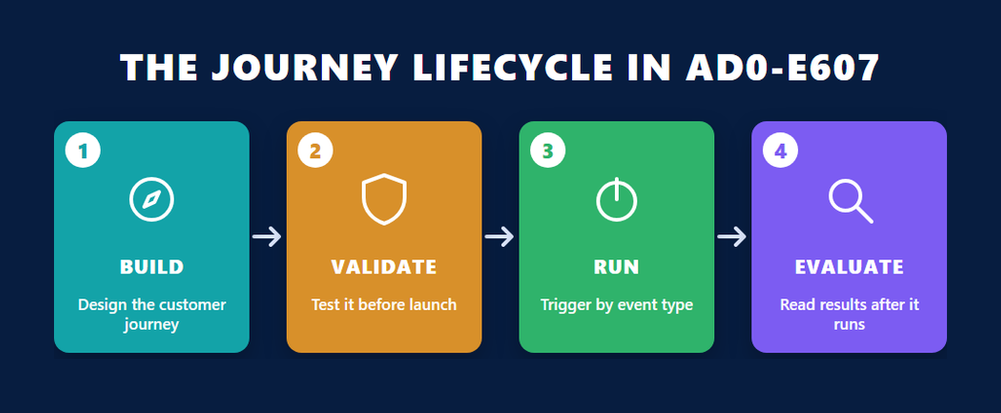
The four objectives describe a lifecycle. Building covers the journey canvas: entry conditions, the sequence of actions and conditions, wait steps, and the channels used at each step. Validation is the checking step before publication, where test profiles run through the canvas and the error panel is read. Evaluation happens after the journey is live, when reports show how many profiles entered, where they exited and which messages were delivered.
Adobe’s own documentation frames the product the same way: journeys that are designed, orchestrated and then optimised from their performance data. The Journey Optimizer documentation is organised around exactly those stages, with separate guides for journeys, campaigns and channels, and it is the most direct reference for this domain.
Unitary events and business events
The fourth objective is the one candidates most often get wrong. A unitary event is tied to a single profile: a purchase, an app open, a form submission. A business event is not tied to any profile, such as a flight delay or a price drop, and it starts a journey for every qualifying profile at once. The exam gives a situation and asks which trigger fits, so practise classifying real examples before test day.
Scenario questions in this domain reward hands-on time, and the quickest way to see how they are phrased is to work through the AD0-E607 sample questions and note which lifecycle stage each one is probing. Treat every wrong answer as a pointer to a documentation page you have not read yet.
How Do Offer Decisioning and Content Authoring Fit Together?
Offer Decisioning (12 percent) and Content Authoring (20 percent) are tested separately on AD0-E607 but used together in practice: an offer is decided for a profile, then placed into an email, a push message or a page by a decision activity inside the content. Between them they account for 32 percent of the exam, around 16 questions, and they share the theme of personalisation at scale.
Offer Decisioning: six objectives, twelve percent
The offer objectives follow the order of the work. You create a collection of offers, understand the stages of decisioning, configure an individual offer, and then use decision activities in content being authored. Two objectives are judgement calls: when to use offer decisioning rather than personalisation at scale, and how static offers differ from dynamic ones. A static offer has fixed content; a dynamic offer pulls values from the profile or context at the moment it is rendered.
Content Authoring: seven objectives, twenty percent
Content Authoring is broader. It covers asset essentials, adding personalised fields into emails, configuring and interpreting a content experiment, the benefits and types of fragments, and creating an email template. Fragments are reusable blocks of content shared across messages; the exam asks both why they help and which kinds exist. Content experiments are the A/B testing feature, and the “interpret” objective means reading a result and saying which treatment won and why.
Both domains reward the same habit: knowing where a setting lives and what changes when you flip it. Retail teams running the product describe the payoff in similar terms.
“With a unified structure for customer profiles and journeys, we’ve improved collaboration across our teams and can respond quickly as changes happen. We also use real-time dashboards to track performance, so the team can see how their work impacts the business.”
What Does Foundations of AEP Mean for a Marketer?
Foundations of AEP is the 20 percent of AD0-E607 that covers Adobe Experience Platform, the data layer Journey Optimizer runs on. Its eight objectives ask a business practitioner to recognise data types, read profile attributes and audience membership, tell profile-enabled datasets from the rest, know the identity types a journey supports, choose audience types and sequential logic, troubleshoot a data load and pick the right data label.
Profiles, identities and datasets
Adobe Experience Platform centralises customer data from many systems into a single profile, and Journey Optimizer reads that profile to decide who enters a journey and what they receive. The exam does not ask you to build a schema, which belongs to the Developer Expert exam. It asks whether you know that a dataset must be enabled for profile before its records appear on a customer record, and where to look up an individual’s attributes and audience membership when a journey behaves unexpectedly.
Identities matter because a journey can be triggered by an email address, a customer ID or a device ID, and the choice determines which profiles the event reaches. The Experience Platform overview is the right starting point for this domain, because it explains the profile, identity and dataset concepts in the same terms the exam uses.
Audiences, troubleshooting and labels
Two objectives deal with audiences: which audience type to use in a scenario, and the right logic for a sequential audience, where a profile must do one thing and then another in order. One objective covers troubleshooting a data loading issue, which in practice means checking dataset status and ingestion failures before blaming the journey. The last asks which data label applies, and data labels are the governance tags that control how sensitive fields can be used in marketing.
If you already work with Adobe’s customer data platform, this domain will feel familiar. The Real-Time CDP certification path covers the same profile and identity foundation from the data side, and the two credentials pair naturally.
Business Practitioner Professional or Developer Expert: Which One?
Choose AD0-E607 Business Practitioner Professional if you build journeys, offers and content as a marketer or campaign owner; choose AD0-E606 Developer Expert if you configure the platform, manage permissions and APIs, and model data. Both are 50 questions in 100 minutes, but the Developer exam costs $225, needs 33 correct answers, and spreads its marks across five technical domains.
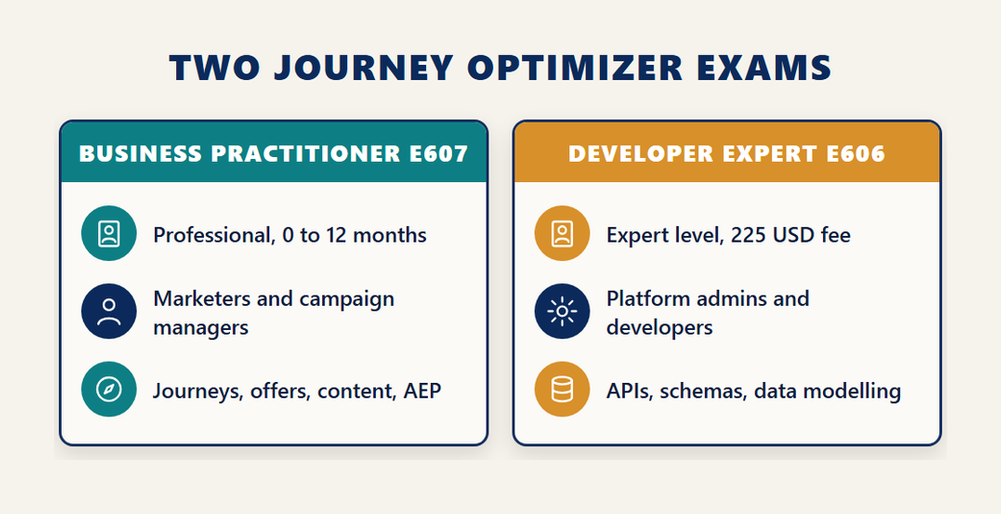
| Attribute | AD0-E607 Business Practitioner Professional | AD0-E606 Developer Expert |
|---|---|---|
| Level | Professional | Expert |
| Fee | $125 | $225 |
| Questions and time | 50 in 100 minutes | 50 in 100 minutes |
| Passing score | 31 of 50 | 33 of 50 |
| Largest domain | Campaign and Journey Optimization, 48% | Journey Orchestration and Content Authoring, 22% each |
| Other domains | Content Authoring 20%, Foundations of AEP 20%, Offer Decisioning 12% | Administration and Configuration 20%, Data Modeling 18%, Offer Decisioning 16% |
The Developer Expert syllabus includes permissions, sandboxes, channel administration, throttling and capping APIs, schemas, datasets and segmentation services. None of those words appear in the Business Practitioner objectives. Conversely, content experiments, fragments and data labels appear on the Professional exam and are only touched on the Developer one.
A common path is to take AD0-E607 first, since it has the lower fee and the lower experience expectation, and move to AD0-E606 once you are the person others ask to fix the configuration. Nothing stops you taking the Developer exam first, but its five-domain spread assumes you have already worked inside the admin screens.
Who Should Take AD0-E607?
AD0-E607 is written for people with up to twelve months on Adobe Journey Optimizer who own campaigns and journeys rather than platform configuration. Adobe lists the target roles as Journey Optimizer business consultant, marketer, marketing automation business practitioner, campaign manager, journey manager, digital marketing specialist, CRM coordinator and MarTech analyst, and the exam content follows that list closely.
Experience level
Professional is Adobe’s entry tier, and the zero to twelve months guidance is a description of who the questions were written for rather than a prerequisite. There is no required prior certification and no proof of experience to submit. If you have built a handful of live journeys and sent a personalised email from the product, you are already inside the intended range.
Where it fits in a marketing career
Journey Optimizer belongs to the broad category of marketing automation software, and the skills the exam measures transfer across that category: triggered messaging, audience logic, content personalisation and experiment reading. In the United States, PayScale reports an average salary of about $74,700 for a marketing automation specialist, with a range from roughly $52,000 to $99,000. The certification does not set your pay, but it is the kind of evidence that moves a candidate within that range.
Marketers who already hold an Adobe Analytics credential will recognise the format. The Adobe Analytics Business Practitioner exam uses the same scenario style at the same Professional level, and reporting on journey results is where the two products meet.
How Much Does It Cost and How Does Renewal Work?
AD0-E607 costs $125 USD, or $95 for candidates in India, and the certification is valid for two years from the date you pass. Renewal is free: Adobe asks you to complete two short courses of roughly fifteen minutes each before the expiry date, and it notifies you 180 days in advance. There is no renewal exam and no renewal fee.
What the fee covers
The fee buys one attempt at the online proctored exam, delivered in English, with a camera required for the whole session. Budget separately for the AJO-BP200 course if your organisation does not already have access to Adobe’s learning content, and for the time to work through it: Adobe lists the course at about six hours.
The two-year clock
Because renewal is two short courses rather than a fresh exam, the sensible move is to complete them as soon as the 180-day notice arrives. Letting the credential lapse means sitting AD0-E607 again at full price. Adobe’s renewal courses also track product changes, which is how the certification stays tied to the current release of Journey Optimizer without a versioned exam code.
How Should You Prepare for AD0-E607?
Prepare for AD0-E607 in the order of the weightings: journeys first, then content and platform foundations, then offers. Adobe’s recommended course is AJO-BP200, Adobe Journey Optimizer for Business Practitioners (Professional), a six-hour programme that maps onto the four domains. Pair it with hands-on time in a sandbox and timed practice at the 100-minute, 50-question pace.
- Complete the AJO-BP200 course end to end before opening any other material, so the vocabulary in every later step is Adobe’s own.
- Build three journeys of your own in a sandbox: one started by a unitary event, one by a business event, and one by an audience qualification, and validate each with a test profile.
- Read the Experience Platform overview and locate a profile’s attributes, identities and audience membership in the interface until you can find them without searching.
- Create an email template with fragments and personalised fields, then run a content experiment on it and write down what each result panel means.
- Configure one offer collection with a static and a dynamic offer, and place a decision activity in a message so you have seen the whole chain once.
- Sit two full timed practice tests at 50 questions in 100 minutes and review every miss against the objective it belongs to before booking the exam.
Pacing on the day
Two minutes per question is comfortable for recall items and tight for scenarios. Answer the “Identify” questions quickly and bank the time for the “Given a scenario” items in the journey domain, where a careful second read often changes the answer. With 31 needed out of 50, leaving nothing blank is the single most useful rule.
Frequently Asked Questions
Is there an Adobe Journey Optimizer certification?
Yes. Adobe offers AD0-E607, the Adobe Journey Optimizer Business Practitioner Professional certification, and AD0-E606, the Adobe Journey Optimizer Developer Expert certification. The Business Practitioner exam is aimed at marketers and campaign owners; the Developer exam is aimed at the people who configure the platform.
How many questions are on the AD0-E607 exam?
AD0-E607 has 50 questions and a time limit of 100 minutes. The passing score is 31 correct answers out of 50, which is 62 percent. The exam is delivered online with a proctor and requires camera access for the full session.
What does AJO stand for?
In Adobe’s product world AJO is the abbreviation for Adobe Journey Optimizer. The same three letters are also a Spanish word for garlic and the name of a town in Arizona, so searching for the certification by its full product name returns far more relevant results than the acronym does.
How much does the Adobe Journey Optimizer Business Practitioner exam cost?
The AD0-E607 exam fee is $125 USD worldwide and $95 for candidates in India. The fee covers one attempt. The recommended AJO-BP200 course is separate and runs about six hours.
Which domain is the largest on AD0-E607?
Campaign and Journey Optimization is the largest domain at 48 percent, which is around 24 of the 50 questions. Content Authoring and Foundations of AEP are 20 percent each, and Offer Decisioning is 12 percent.
How long is the Adobe Journey Optimizer certification valid?
The certification expires two years after you earn it. Adobe notifies you 180 days before the expiry date, and you renew by completing two short courses of about fifteen minutes each at no cost. No renewal exam is required.
What is the difference between AD0-E607 and AD0-E606?
AD0-E607 is the Professional-level Business Practitioner exam: $125, 31 of 50 to pass, four domains led by journeys at 48 percent. AD0-E606 is the Expert-level Developer exam: $225, 33 of 50 to pass, five domains covering administration, orchestration, offers, content and data modelling.
Do I need experience before taking AD0-E607?
No formal prerequisite exists. Adobe describes the Professional level as suited to candidates with zero to twelve months of experience on Journey Optimizer, and the scenario questions assume you have built and validated journeys in the product at least a few times.
What is the best way to prepare for the AD0-E607 exam?
Take the AJO-BP200 course, then spend the most time on journeys because they are 48 percent of the marks. Build journeys in a sandbox with both event types, practise reading content experiment results, and finish with timed practice tests at the real pace of 50 questions in 100 minutes.
Conclusion
The Adobe Journey Optimizer certification that most marketers want is AD0-E607, and its shape is unusually clear: 50 questions, 100 minutes, 31 to pass, and nearly half the marks on building, validating and evaluating journeys. The remaining domains, content authoring, platform foundations and offer decisioning, are smaller but cannot be skipped, since a passing score leaves room for only 19 misses.
Decide first whether you are the practitioner or the developer, because the two exams share a product and little else. Then prepare in weighting order, keep hands-on time in a sandbox at the centre of the plan, and treat the two free renewal courses as part of owning the credential rather than an afterthought. The sample questions linked earlier are a quick way to see where you stand before you book.


