The CTSC certification is not a planning exam, and it is not a logistics exam. ASCM already has credentials for running the supply chain you have. The APICS Certified in Transformation for Supply Chain exists for a different job: taking that supply chain apart on purpose, deciding what it should become, and leading the people and projects that get it there without breaking the business along the way.
That difference decides whether CTSC is the right next step for you. This article covers what the credential is for, who it suits better than CSCP or CPIM, how the 150 question exam is set up, what each of its four topic areas asks, and how to prepare for a syllabus that leans heavily toward the work done before a transformation even starts.
Table of Contents
- What Is the CTSC Certification For?
- Who Should Take CTSC Instead of CSCP or CPIM?
- How Is the CTSC Exam Structured?
- What Do the Four CTSC Topic Areas Cover?
- Why Does Preparation Fill Most of the CTSC Syllabus?
- How Do Change Management and Governance Show Up?
- What Does the Review Phase Test?
- How Should You Prepare for the CTSC Exam?
- Is the CTSC Certification Worth It for Your Career?
- Frequently Asked Questions About the CTSC Certification
- Conclusion
What Is the CTSC Certification For?
The CTSC certification recognises supply chain professionals who can start and lead a supply chain transformation. ASCM launched it in July 2023 for mid-level people who support or carry out transformation work in their organisations, and it tests whether you can move an operation from its current state to a better future state with a structured method rather than guesswork.
ASCM, the Association for Supply Chain Management, built the credential on parts of its own published standards: SCOR DS, the Enterprise Standards for Sustainability, and the Digital Capabilities Model. In practice, that means the exam expects you to know how these reference models describe a supply chain, and how to use them when you assess one and plan its change.
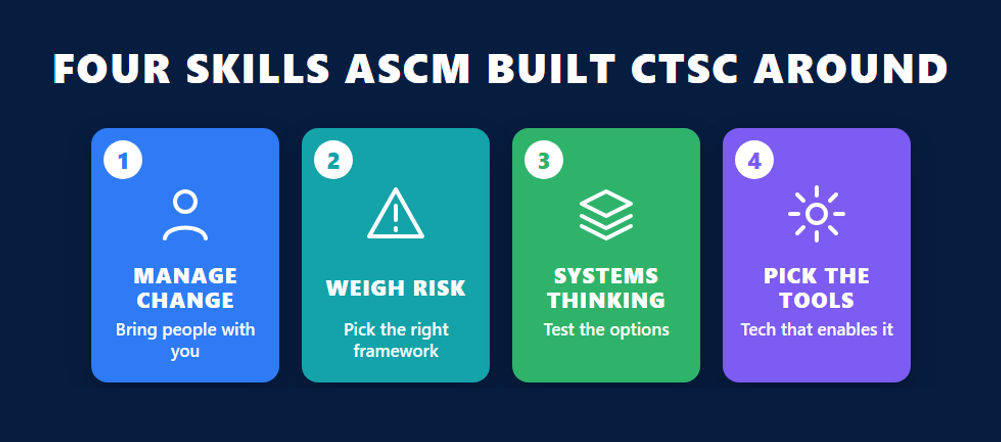
The ASCM launch announcement set out four capabilities the program aims to build: managing change through a transformation, weighing risks and opportunities to choose the right frameworks and approaches, applying systems thinking to develop and validate alternative concepts, and identifying the tools and technologies that make the change work.
“Holders of the CTSC credential will be able to gain a competitive advantage in the market by demonstrating their understanding of supply chain transformation frameworks and best practices.”
Why the Name Causes Confusion
You will see the same credential written as CTSC, APICS CTSC and ASCM CTSC. APICS is the long-standing brand ASCM keeps on its certifications, so all three names point to one exam. Searching for the bare acronym can also surface unrelated results, because CTSC is used in other industries, which is why most candidates search the full name: Certified in Transformation for Supply Chain.
Who Should Take CTSC Instead of CSCP or CPIM?
Take CTSC if your job is changing how the supply chain works, and take CSCP, CPIM or CLTD if your job is running it well. CSCP covers the end-to-end supply chain, CPIM covers planning and inventory, and CLTD covers logistics, transportation and distribution. CTSC sits beside them and focuses on the method of transformation itself.
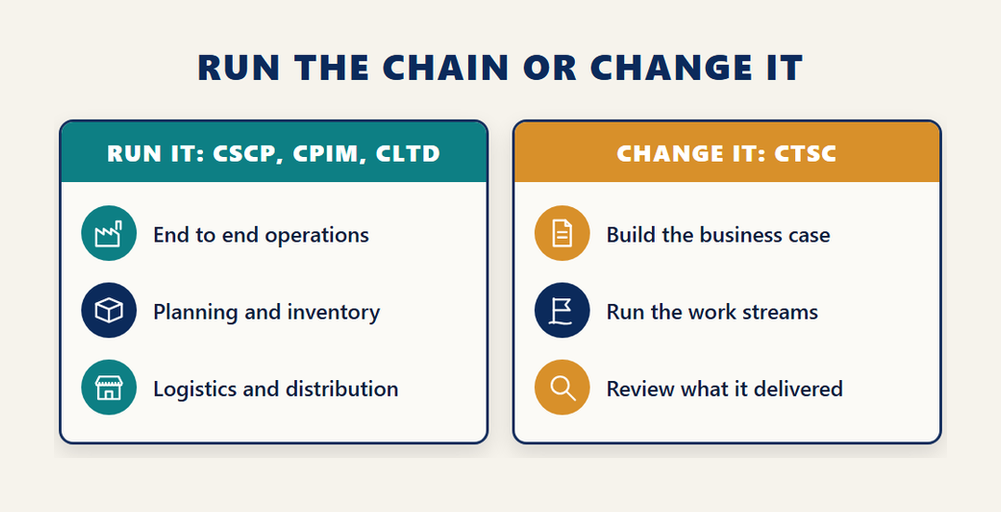
The people who get the most from CTSC tend to fall into a few groups:
- Operations or supply chain managers who have been handed a redesign, a network change or a digital program
- Members of a transformation office or project management office working on supply chain initiatives
- Consultants who assess clients’ supply chains and recommend a future-state model
- Planners and analysts moving from day to day execution into improvement and change roles
If you are earlier in your career and still building core supply chain knowledge, an operational credential usually makes more sense first. CTSC assumes you already understand how a supply chain runs, because it asks you to judge what should change and in what order.
How Is the CTSC Exam Structured?
The CTSC exam is a single sitting of 150 multiple choice questions in 210 minutes, scheduled through Pearson VUE. The passing score is 300 on a scale that tops out at 350, and the published exam fee is USD 2,275. Every question is multiple choice, so the sitting rewards careful reading of each situation rather than hands-on work in a live system.
| Exam detail | CTSC |
|---|---|
| Full name | ASCM APICS Certified in Transformation for Supply Chain |
| Exam code | CTSC |
| Number of questions | 150 |
| Duration | 210 minutes |
| Passing score | 300 / 350 |
| Format | Multiple choice questions |
| Exam fee | USD 2,275 |
| Scheduling | Pearson VUE |
ASCM has said that CTSC pricing depends on your ASCM membership type, so treat the listed fee as a reference point and confirm your own price with ASCM before you budget. The score is reported on a scale rather than as a percentage, so there is no published figure for how many questions you must answer correctly.
The question style rewards judgment more than recall. Sample items describe a situation a transformation team faces and ask how the program should proceed, what the team must do next, or which tool fits. Working through realistic CTSC sample questions early shows you how the scenarios are worded and where your reasoning drifts from the body of knowledge.
What Do the Four CTSC Topic Areas Cover?
The CTSC syllabus has four topic areas that follow a transformation from start to finish: an overview of transformation, preparing for it, executing it, and reviewing it. Together they contain fifteen subtopics. No weightings are published for these areas, so the subtopic count is the clearest guide to where the content is concentrated.
| Topic area | Subtopics |
|---|---|
| Supply Chain Transformation Overview | Supply Chain Transformations; Value Proposition, Methodologies, and Organizational Design; Drivers of Supply Chain Transformation |
| Preparing for Supply Chain Transformation | Select Supply Chain Transformation Drivers; Assess Supply Chain Current State; Conceptualize the Future-State Supply Chain Operating Model; Identify Initiatives to Address Gaps; Initiate Transformation Work Streams and Projects; Develop and Iterate Preliminary Transformation Business Cases; Perform Post-Approval Tasks |
| Executing Supply Chain Transformation | Adopt a Change Management Plan; Design and Implement Supply Chain Transformation Work Streams and Projects; Implement Governance and a Risk Management Framework |
| Review of Supply Chain Transformation | Assess the Transformation; Communicate Results and Reflect on the Transformation |
The overview area sets the vocabulary. You need to explain what counts as a transformation rather than an ordinary improvement, how a transformation creates value, which methodologies organisations use, and how organisational design supports or blocks the change. The drivers subtopic asks why companies transform at all, from cost pressure to disruption and new technology.
Why Does Preparation Fill Most of the CTSC Syllabus?
Preparing for Supply Chain Transformation holds seven of the fifteen subtopics, almost half the syllabus, because most transformations succeed or fail before execution begins. This area covers choosing the drivers, assessing the current state, designing the future-state operating model, closing gaps with initiatives, and building the business case that gets the program approved.
From Current State to Future State
The logic runs in sequence. You select the drivers that matter for this organisation, assess how the supply chain performs today, and then conceptualise the future-state operating model. The gap between the two becomes a list of initiatives, and those initiatives are grouped into work streams and projects that someone can actually own.
Expect questions that test the order of these steps. Designing a future state before assessing the current one, or launching projects before the gaps are understood, are the kinds of mistakes the exam is built to catch.
The Business Case Is Iterative
The syllabus says the preliminary business case is developed and iterated, not written once. As the assessment sharpens, costs, benefits and risks are revised. Once the program is approved, a further subtopic covers the post-approval tasks that turn a decision into a funded, staffed plan. Candidates who have only ever executed projects often find this financial and approval side the least familiar.
How Do Change Management and Governance Show Up?
The Executing Supply Chain Transformation area tests three things: adopting a change management plan, designing and implementing the work streams and projects, and putting governance and a risk management framework in place. It is about keeping a multi-project program on course while people, processes and systems all change at once.
Change management carries real weight in the questions, because a technically sound redesign still fails if the people who run the supply chain do not adopt it. The discipline has its own professional body, the Change Management Institute, and its body of knowledge is a useful companion for the stakeholder, communication and resistance topics the exam raises.
Governance and risk questions ask who decides, how progress is tracked, and what happens when a work stream slips or a risk becomes real. The systems view matters here as well. A change to inventory policy affects transportation, service levels and cash, so the exam rewards answers that consider the whole chain. If the idea is new to you, a short grounding in systems thinking concepts makes these scenarios easier to read.
What Does the Review Phase Test?
The Review of Supply Chain Transformation area has two subtopics: assessing the transformation, and communicating results and reflecting on it. It checks whether you can measure what the program delivered against the business case, share those results with stakeholders, and capture lessons that improve the next transformation.
This is the smallest area, and that makes it easy to underprepare. Do not skip it. Review questions often link back to earlier decisions: whether the original drivers were the right ones, whether the business case assumptions held, and how the results should be reported to the people who approved the investment.
How Should You Prepare for the CTSC Exam?
Prepare for the CTSC exam by following the transformation lifecycle the syllabus uses, spending the most time on preparation, which holds seven of the fifteen subtopics, and practising scenario questions throughout. Your aim is to recognise which phase a situation sits in and which step comes next, so learn the sequence before the detail.
- Map the four topic areas and fifteen subtopics. Write them out in order so you can see the lifecycle from overview to review before reading anything else.
- Learn the reference models first. Get comfortable with how SCOR DS, the Enterprise Standards for Sustainability and the Digital Capabilities Model describe a supply chain, because preparation questions rely on them.
- Study the preparation area in depth. Work through drivers, current-state assessment, future-state design, gap initiatives, work streams and the iterative business case until you can explain why each step follows the last.
- Cover execution and review next. Focus on change management, governance, risk and how results are assessed and communicated.
- Practise with scenario questions and review every mistake. For each wrong answer, name the phase and the step you misread, then return to that part of the syllabus.
Plan your time around the 210 minute sitting as well. At 150 questions, steady pacing leaves room to flag hard scenarios and come back to them. A focused collection of CTSC exam materials helps you keep the syllabus, notes and practice in one place while you work through these steps.
Is the CTSC Certification Worth It for Your Career?
The CTSC certification is worth it if you lead or want to lead supply chain change, because it is one of the few credentials that certifies the transformation method itself rather than an operational function. It gives you a shared vocabulary with transformation offices and consultants, and a structured way to plan, run and review change programs.
Its value depends on fit. If your work is mostly day to day planning or logistics, an operational credential will map more closely to your role. Many professionals build a foundation first and add CTSC once they are responsible for change. If you are still weighing that broader foundation, the CSCP certification path is the usual starting point in the ASCM family.
The credential also signals something specific to employers. Transformation programs are expensive and visible, and a hiring manager filling a role on one wants evidence that you understand the full sequence: drivers, assessment, design, business case, execution, governance and review. CTSC shows exactly that sequence.
Frequently Asked Questions About the CTSC Certification
What does CTSC stand for?
CTSC stands for Certified in Transformation for Supply Chain. It is an ASCM certification carrying the APICS brand, so it also appears as APICS CTSC or ASCM CTSC.
How many questions are on the CTSC exam?
The CTSC exam has 150 multiple choice questions, which you answer in a single sitting of 210 minutes.
What is the passing score for the CTSC exam?
The passing score is 300 on a scale that tops out at 350. The result is a scaled score, so there is no published percentage of correct answers needed to pass.
How much does the CTSC exam cost?
The published exam fee is USD 2,275. ASCM has said CTSC pricing depends on your membership type, so confirm your own price with ASCM before you book.
Where do you take the CTSC exam?
The CTSC exam is scheduled through Pearson VUE.
How many topic areas does the CTSC syllabus have?
It has four topic areas: Supply Chain Transformation Overview, Preparing for Supply Chain Transformation, Executing Supply Chain Transformation and Review of Supply Chain Transformation, with fifteen subtopics in total.
Are the CTSC topic weightings published?
No weightings are published on the syllabus, so the subtopic count is the best guide. Preparing for Supply Chain Transformation holds seven of the fifteen subtopics.
Is CTSC better than CSCP?
Neither is better in general. CSCP covers running the end-to-end supply chain, while CTSC covers leading its transformation. Choose the one that matches the work you do or want to do next.
Who is the CTSC certification designed for?
ASCM designed it for mid-level professionals who support or carry out supply chain transformation in their organisations.
Conclusion
The CTSC certification is ASCM’s credential for the people who change supply chains rather than run them. Its exam is 150 multiple choice questions in 210 minutes, with a passing score of 300 on a scale that tops out at 350, booked through Pearson VUE. The syllabus follows a transformation from overview to review, and nearly half of it sits in preparation: drivers, current-state assessment, future-state design, initiatives, work streams and an iterative business case.
If you are leading or about to lead supply chain change, study that lifecycle in order, give preparation the most time, and practise scenario questions until you can name the phase and the next step in any situation. Then book your sitting and confirm your price with ASCM.


